What a fibreglass pool costs in Australia
Every part of the job, what it costs in 2026, and where each number came from. Updated 19 September 2026.
The short answer
For a typical 7 metre fibreglass pool in a suburban backyard with reasonable access:
| The kit, delivered | The shell, the equipment package, the engineering pack and freight. See the bands below, or get the instant estimate for your pool and region. |
| The rest of the work | $30,000 to $60,000 quoted, depending on access, ground, and how far you go on paving and fencing. |
| Fully installed, all in | $55,000 to $85,000 is the honest band for a finished job in Sydney. |
If you have been quoted well over $100,000 for a 7 metre fibreglass pool, something in that quote is either very expensive or very profitable. Ask for it itemised.
What the kit costs, by size
This is our own pricing, inc GST, for the Essentials equipment package. It includes the Australian-made shell in any of the twelve colours, the equipment that runs it, the engineering pack with your state's certificate, and freight. Distance moves it, which is why three regions are shown.
| Pool size | Mid North Coast | Sydney | Brisbane |
|---|---|---|---|
| Plunge, under 5 m | $18,000 to $20,000 | $20,000 to $22,000 | $21,000 to $23,000 |
| Small family, 5 to 6 m | $19,000 to $23,000 | $20,000 to $24,000 | $22,000 to $26,000 |
| Family, 6 to 7.5 m | $21,000 to $25,000 | $23,000 to $27,000 | $25,000 to $28,000 |
| Large, 8 to 9 m | $23,000 to $29,000 | $25,000 to $31,000 | $27,000 to $32,000 |
| Extra large, 10 m and up | $28,000 to $30,000 | $29,000 to $32,000 | $31,000 to $33,000 |
Bands are rounded. The exact number comes from your address. Get an instant estimate.
What each trade charges
This is the same list a builder works from. These are direct trade costs, what the excavator, the crane operator and the electrician charge the person organising the job. They are not what a builder quotes you. A builder's quote also carries their site costs, overheads, margin and a contingency for what the ground does, which is what pays for coordinating six trades and warranting the finished work.
| Item | Cost | Where it came from |
|---|---|---|
| Excavation, machine, good access | $45 to $95 per m3 | Trade rates, Sydney 2026 |
| Excavation, restricted or hand work | $200 to $350 per m3 | Trade rates, Sydney 2026 |
| Rock, if you hit it | $250 to $450 per m3 | Indicative. Get a real quote once you know what is down there |
| Spoil removal, 7 m pool | $2,500 to $5,000 | Market range. Clean fill is cheaper to dump than mixed waste |
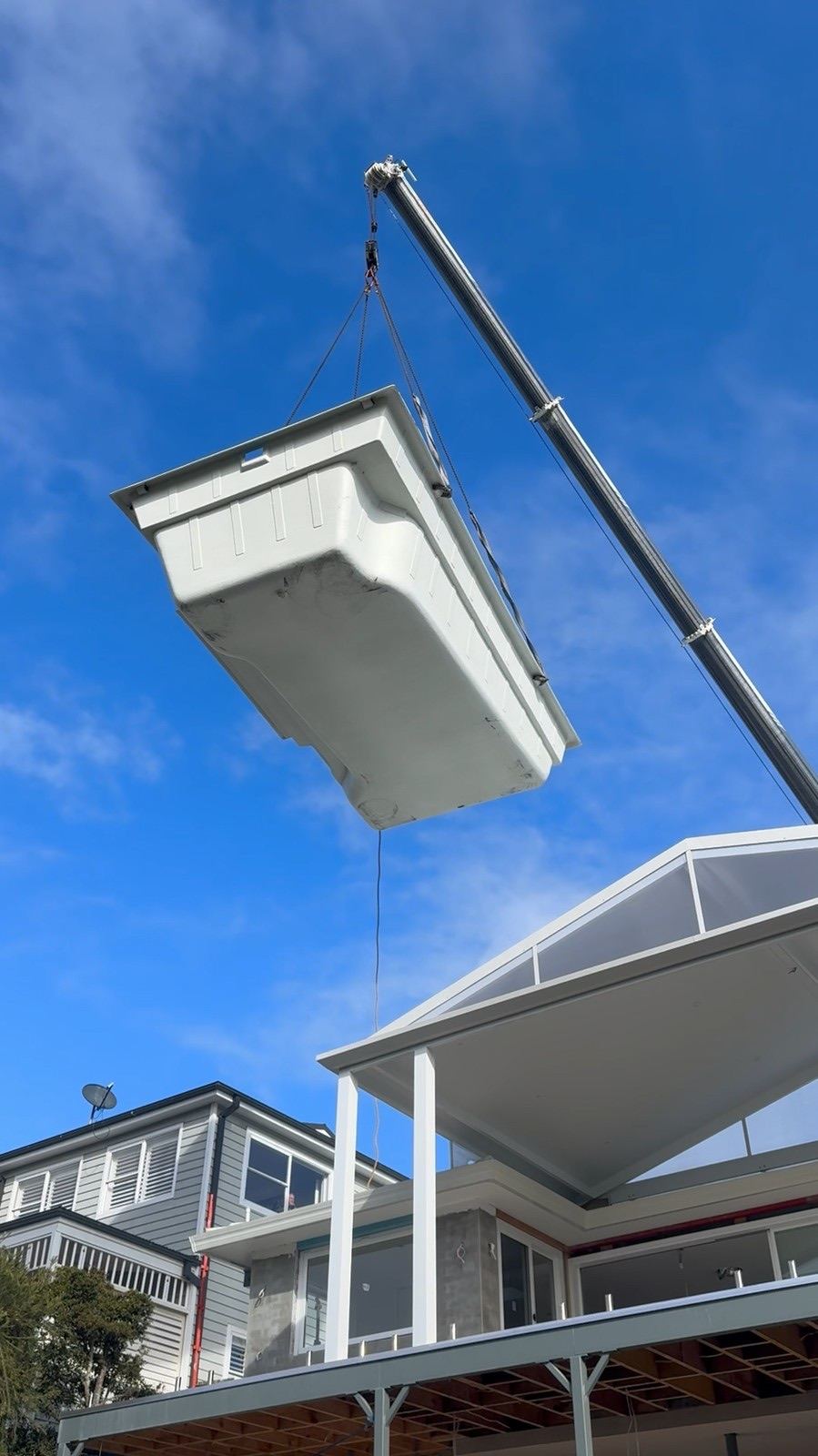
| Crane and set | $1,800 to $3,200 per day, plus float | Trade rates, Sydney 2026. Most lifts are a half day, you pay a minimum |
| Survey and set-out | $1,200 to $3,000 | Trade rates, Sydney 2026 |
| Geotechnical report, where council wants one | $1,500 to $4,000 | Trade rates, Sydney 2026 |
| Private certifier | $1,500 to $5,000 | Trade rates, Sydney 2026 |
| Pool plumbing and PVC | $3,000 to $6,000 | Market range. More if the equipment sits a long way from the pool |
| Electrical | $1,500 to $4,000 | Market range. A dedicated circuit plus lighting, licensed electrician only |
| Backfill and bond beam | $2,500 to $5,000 | Market range. Crusher dust or concrete surround, plus the beam |
| Coping and paving, plain concrete | $140 to $200 per m2 | Indicative |
| Coping and paving, stone or travertine | $250 to $450 per m2 | RLB Riders Digest Sydney 2026 |
| Pool fencing, aluminium | $80 to $150 per m | Market range |
| Pool fencing, frameless glass | $300 to $450 per m | Market range |
| Landscaping and turf | $210 to $280 per m2 | RLB Riders Digest Sydney 2026 |
| Filling it | $300 to $900 | Market range. Mains water or a carter, depending on supply and restrictions |
Change three things and the picture moves a long way. Put the pool over the house instead of down the side, hit sandstone at 1.2 metres, and choose travertine coping, and the works alone land closer to $60,000. That is why nobody quotes a pool off a phone call, and it is also why an itemised quote is the only kind worth comparing.
Three ways to buy, and what each costs you
| Way | What you pay for | What it means |
|---|---|---|
| You install it | The kit, delivered. You book the excavator, the crane and the trades, and you run the job. | Cheapest way to a finished pool. You carry the coordination and the risk of a step going wrong. |
| Your builder installs it | The kit, delivered. Your builder or landscaper runs the install with their own crew. | Common where a build or a landscaping job is already happening. You pay their margin on the install, not on the pool. |
| Our licensed crew installs it | NSW and Queensland, on sites that suit. Priced after we have looked at your block. | Fewest phone calls for you. In Victoria we deliver only, so the install is you or your builder. |
Read supply only or fully installed for the longer comparison, and the owner-builder guide if you are running it yourself, because plumbing and electrical still need licensed trades.
The four things that actually move the number
Access
The single biggest swing. A machine down the side is cheap. Everything craned over a roof means a bigger crane, a traffic plan, sometimes a road closure. If your side access is under about 900 mm, assume a crane and budget for it early. Our delivery and crane access guide covers how to check yours.
What is under the grass
Sand is quick. Clay is fine. Sandstone can add five figures. Nobody knows until someone digs, which is why a good builder gives you a rock provisional sum rather than pretending it will not happen. If your neighbours hit sandstone, assume you will too.
How far you take the surrounds
Coping, paving and landscaping are where a $50,000 job becomes an $80,000 one, and they are almost entirely discretionary. Plain concrete now and stone in two years is a completely legitimate plan. The pool does not care.
Fencing choice
Frameless glass looks better and costs two to five times aluminium. Over 30 metres that is a decision worth thousands on looks alone. A compliant barrier is not optional, the material is.
What it costs to run
Running cost comes down to four things, and most of them are decided when you buy the equipment rather than later.
- The pump. A variable speed pump uses a fraction of the power of a single speed pump at the same turnover, because it runs longer at lower speed. It is the single biggest lever on your power bill, and it is in every kit we sell.
- Heating. A heat pump is usually the cheapest way to heat a pool, and a blanket is what makes it affordable, because most of the heat a pool loses goes off the surface overnight.
- Chemicals. A mineral chlorinator makes its own chlorine from the salt in the water, so you buy salt rather than drums of liquid chlorine. Automatic pH control keeps the dosing steady instead of you chasing it.
- Water. Topping up over summer, and backwashing a media filter. A cartridge filter skips the backwash if you are on tank water.
Anyone who gives you a single dollar figure for running a pool is guessing at your tariff, your climate and how long you run the pump. Ask for the assumptions behind any number you are quoted.
How long it takes
The shell is made to order, so the lead time is about eight weeks heading into summer, and three to six weeks off season. Once it arrives, the shell is set in a day or two. Then the trades connect it, the barrier goes up and is inspected, and the pool is filled and balanced. The week by week timeline sets out the whole run.
Where the real savings are
- Buy the kit direct. A showroom markup on the pool itself is the easiest money you will ever save, and the shell is the same one.
- Keep the labour. Install is the biggest line in a turnkey quote. Doing it yourself, or using a builder you already have, keeps it in your pocket.
- Stage the surrounds. Plain concrete and aluminium fencing now, stone and glass later. Nothing about the pool changes.
- Pick a shape that suits your access. A pool that fits down the side instead of over the roof can save thousands before anyone starts digging.
- Get the rock question answered early. A bore log, $1,500 to $4,000, beats a $20,000 surprise.
The costs people forget
These are the lines that turn a budget into a surprise. None of them are exotic, and all of them are easier to plan for than to discover.
- Temporary fencing. From the day the hole is open until the permanent barrier passes inspection, the site has to be fenced. Hire is weekly, so a long job costs more than a short one.
- Traffic control. A crane on the street can mean cones, a permit and a traffic controller, especially on a bus route or a main road. Your crane company will tell you, but usually only once you ask.
- Crane float. Getting the crane to your street and away again is charged on top of the lift itself.
- Spoil you cannot reuse. Clean fill is cheap to dump. Mixed clay, roots and building rubble is not, and the distance to the tip is the multiplier.
- Tree removal and root damage. A tree in the lift path or the dig zone can need an arborist report and council consent before it comes out.
- Switchboard capacity. A pump, a light and later a heat pump all land on one circuit. An older board sometimes needs an upgrade before the electrician can sign it off.
- Retaining and levels. On a sloping block the pool sits level, so one side ends up proud of the ground. That edge becomes a retaining wall or a raised deck, and it is real money.
- Reinstating the lawn. A dig, a crane and six weeks of trades will finish your grass. Turf is the last line on every pool job and it is never small.
- Water and power during the build. Filling is one bill. Running the pump while the water balances is another.
- The barrier inspection and the register. In New South Wales the pool is registered before anyone swims, and a certifier charges for the inspection.
Fibreglass against concrete, on cost
The full comparison is in the honest comparison guide. On money alone, the differences are these.
| Line | Fibreglass | Concrete |
|---|---|---|
| The shell | Made in a factory, one price, delivered | Built on site over weeks by several trades |
| Time on site | Days to set, then trades | Months, with more site costs and more supervision |
| Interior over time | Gelcoat, no resurfacing cycle | Interior finish is replaced on a cycle, and it is a big bill |
| Chemicals | Non-porous surface, so generally less | Porous surface, generally more |
| Shape and size | What the moulds make, which is where concrete wins | Anything you can draw |
Questions to ask any pool quote
Take this list to every quote you get, including ours. The answers tell you more than the total does.
- Is this itemised, and what is the trade cost against the margin on each line?
- What is allowed for excavation, and what happens if you hit rock?
- Is the crane in the price, and is the float and traffic control in it too?
- Whose name is on the engineering and the compliance certificate?
- What is the deposit, when is the balance due, and what happens if council says no?
- What is the lead time today, not in a good month?
- Is the equipment named by brand and model, or described as a package?
- Is there a cover, and is it in the price?
- Who connects the plumbing and the electrical, and are they licensed?
- What is excluded? This is the question that finds the difference between two quotes.
A worked example: a 7 metre pool at Port Macquarie
Numbers mean more with a job attached, so here is one, built from the bands above. An Entertainer 7 on a flat block with side access wide enough for a machine, plain concrete coping and aluminium fencing.
| The kit, delivered | $22,000 to $24,000 inc GST. Shell, Essentials equipment, engineering pack, freight from the factory. |
| Excavation and spoil | Machine access, roughly 40 m3 out, no rock. Trade cost in the thousands rather than the tens of thousands. |
| Crane and set | A half day, plus float. Cheaper again if the machine can place it, which some open blocks allow. |
| Plumbing, electrical, backfill and beam | The core trade work, licensed plumber and electrician. |
| Coping, fencing and turf | Where the budget is yours to set. Plain concrete and aluminium keeps it modest. |
| Approval | Certifier, and a survey if the block needs one. |
Run through the trade ranges above and the works land around $30,000 to $45,000 in a regional area on an easy site, so the finished job sits in the low fifties to high sixties. Put that same pool over a house in Sydney with travertine and glass and you are past ninety. Same pool, same water, completely different job.
Why the same pool costs different money in different towns
Three things change with your postcode, and only one of them is the pool.
- Freight. It moves with distance, which is why the kit bands above differ by region. The shells are made on the mid-north coast, so the Mid North Coast and the Hunter are the shortest runs we do.
- Trade rates. Sydney rates are higher than regional rates for the same work, and the gap is widest on excavation and concreting. The trade table above is Sydney, so treat it as the top of the range if you are out of town.
- Council and ground. Flood levels on a river flat, sandstone on the North Shore, sand on the coast and bushfire rules in the hills all change what the certifier wants and what the excavator hits.
We have written up the local detail for Taree, Port Macquarie, Forster, Maitland, Newcastle, the Central Coast and Sydney.
Where these numbers come from
The landscaping and stone coping figures are from the RLB Riders Digest Sydney 2026, a published cost guide anyone can download. The rest are market ranges from what we see quoted, and we have labelled them as such rather than dress them up. The kit bands are our own prices.
None of it replaces a real quote on your yard. The trade rates above are Sydney rates. If that is where you are building, our Sydney pool page covers local access, council approval and delivery. We also deliver to Newcastle, Port Macquarie, Taree and Brisbane.
Common questions
How much does a fibreglass pool cost in Australia in 2026?
For a typical 7 metre pool in a suburban backyard with reasonable access, a finished job in Sydney lands between about $55,000 and $85,000. Under that means simple access and modest surrounds. Over it means rock, a crane over the house, or a serious landscaping budget.
How much is the pool kit itself?
The kit is the shell, the equipment package, the engineering pack and freight. Our instant estimate shows the delivered range for your pool, size and region, and the exact price comes from your address.
What does the rest of the work cost after the kit?
For a typical 7 metre pool with reasonable access, budget $30,000 to $60,000 quoted for excavation, crane, plumbing, electrical, backfill, coping, fencing and approvals. The trade cost underneath is lower, because a builder's quote also carries their site costs, margin and a contingency for what the ground does.
Is it cheaper to install a fibreglass pool yourself?
Yes, if you have the trades or the time to run the job. Install is the biggest line in a turnkey quote. What you save is the coordination margin, and what you take on is the coordination.
Is a fibreglass pool cheaper than concrete?
Usually yes, and by a good margin. The shell is made in a factory rather than built on site, and it goes in over days rather than months, which takes both labour and time out of the job.
What makes one quote so much higher than another?
Access, ground and surrounds, in that order. A crane over a house, sandstone at 1.2 metres or travertine coping each move the number by five figures. Ask for the quote itemised and the difference usually explains itself.
Do I need council approval?
Yes. Most backyard pools in New South Wales go through as a complying development with a private certifier, and the rest go to council as a development application. The engineered drawings and your state's certificate come in the kit, which is what the certifier asks for first.
What does a pool cost to run?
Less than it used to. A variable speed pump runs at a fraction of the power of a single speed pump, a blanket keeps heat in overnight, and a mineral chlorinator makes its own chlorine from the salt in the water. Your power tariff and how long you run the pump decide the rest.
How long does it take?
The shell is made to order, so lead time is about eight weeks heading into summer, and three to six weeks off season. Once it arrives the shell is set in a day or two, then the trades, the barrier and the fill follow.
Can I get a price without a sales visit?
Yes. Use the instant estimate for a range, or send your suburb and the model and we come back with one delivered number. No obligation and no mailing list.
Want this priced on your actual yard?
Tell us your suburb and the pool you like. We come back with a real delivered number, freight included, no obligation.
Get an instant estimateOr call Will on 0415 140 001